For many growing e-commerce and digital brands in Nigeria, financial bookkeeping is treated as an after-hours administrative chore. Founders and operations managers assume that having an employee spend a few hours every Friday downloading CSV files, copying rows, and aligning columns in Google Sheets is a harmless, low-cost necessity.
It is not.
Manual bookkeeping is one of the most expensive, hidden operational drains on a scaling business. When your team spends hours copy-pasting transaction logs every week[cite: 1], you are not just wasting payroll hours—you are introducing human error, blinding your leadership team to real-time cash flow realities, and burning out your best talent on low-value data entry.
Here is a breakdown of the true cost of manual bookkeeping and how modern e-commerce brands are eliminating it.
1. The True Payroll and Opportunity Cost
Let’s look at the math. Suppose you have an operations officer or a junior accountant whose salary is ₦250,000 a month. They spend approximately 5 hours every week logging into Paystack, Flutterwave, and bank dashboards, exporting CSV files, cleaning messy rows, and pasting them into your master financial sheet.
- Weekly time spent: 5 hours
- Monthly time spent: ~20 hours
- Annual time spent: 240 hours of pure data entry
That is equivalent to six full workweeks every year spent entirely on moving numbers from one digital window to another. At a company level, that is hundreds of thousands of naira paid out for mechanical copy-pasting rather than strategic financial analysis, inventory management, or customer acquisition.
Even worse is the opportunity cost. While your team is busy debugging broken spreadsheet formulas or chasing missing transaction references, they are missing opportunities to optimize supply chains, negotiate better vendor rates, or analyze customer lifetime value.
2. The Danger of Human Error and Blind Spots
Manual data entry is inherently prone to mistakes. A tired employee working late on a Friday afternoon can easily:
- Copy a transaction row twice, artificially inflating your weekly revenue.
- Miss a refund line item, skewing your month-end profit margins.
- Transpose numbers on high-value transaction references, creating reconciliation nightmares during audits.
When your ledgers are built on manual entry, you are never looking at your true financial position. You are looking at a delayed, error-prone approximation of what happened days or weeks ago. If a product line starts losing money on Tuesday, you won't discover it until your weekend audit—long after valuable operating capital has already leaked away.
3. Transitioning From Manual Admin to Automated Infrastructure
To scale past the ₦50 million or ₦100 million annual revenue mark, your business operations must outgrow spreadsheets as a manual tool. You need a system that decouples financial tracking from human labor.
A robust automated bookkeeping infrastructure relies on three core pillars:
- Instant Event Capture: Transactions are logged the exact millisecond they clear on the payment gateway, bypassing manual exports entirely.
- Normalized Data Fields: Gateway fees, gross totals, customer details, and tax slices are automatically separated into clean, structured columns.
- Built-In Reconciliation: Refunds, chargebacks, and failed payouts are flagged and balanced automatically without human intervention.
Eliminate Manual Bookkeeping Entirely
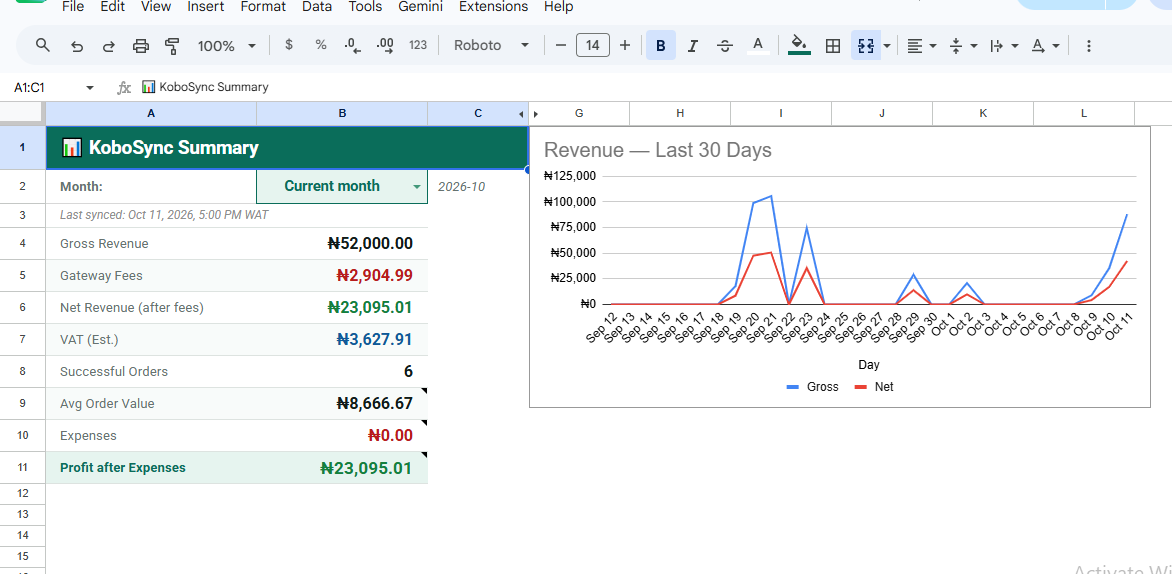
Stop paying your team to waste valuable hours copy-pasting CSV rows every week. KoboSync acts as the secure background automation layer for your commerce operations. The exact millisecond a payment clears on Paystack, Flutterwave, or Monnify, KoboSync processes the webhook, parses your gateway fees, and logs a clean, balanced row directly to your financial dashboard in under 3 seconds[cite: 1].
Final Thoughts: Protecting Your Bottom Line
Your team's energy is your company's most valuable asset. Forcing talented operators to spend hours wrestling with spreadsheet rows is an inefficient use of resources that holds your business back. By automating your bookkeeping pipeline today, you eliminate costly errors, reclaim hundreds of work hours, and give your leadership team the real-time clarity needed to scale with confidence.