As an e-commerce or digital business scales in Nigeria, relying on a single payment gateway quickly becomes an operational risk. To protect against downtime, optimize success rates, and offer diverse payment options, most growing brands route checkouts across multiple providers—such as Paystack for card payments, Flutterwave for international processing, and Monnify for automated virtual bank transfers.
While multi-gateway routing is fantastic for checkout conversion, it creates an absolute nightmare for the finance team.
Every payment provider formats its data differently, structures its settlement timelines on unique schedules, and calculates platform fees using distinct formulas. For financial controllers, unifying these disparate transaction streams into a single, clean accounting framework[cite: 1] is one of the toughest operational challenges of running a modern digital business.
Here is how to master cross-gateway reconciliation and build a unified financial ledger that stays permanently audit-ready.
1. The Multi-Gateway Data Fragmentation Problem
If you log into three different merchant dashboards at the end of the month, you will quickly notice that they do not speak the same language:
- Gateway A exports transaction logs with gross values and appends processing fees at the bottom of the payout settlement report.
- Gateway B outputs logs where every individual transaction is already net of processing fees, making your true gross sales volume completely invisible unless manually recalculated.
- Gateway C batches multiple customer checkouts into a single lump-sum bank settlement payout, separating individual webhook data from the actual cash hitting your corporate bank account.
When your finance team attempts to manually merge these mismatched formats into a master spreadsheet, errors multiply rapidly. Month-end reconciliation turns into a multi-day detective hunt, chasing discrepancies between what your dashboard says you earned and what actually landed in your bank account.
2. Establishing a Standardized Data Schema
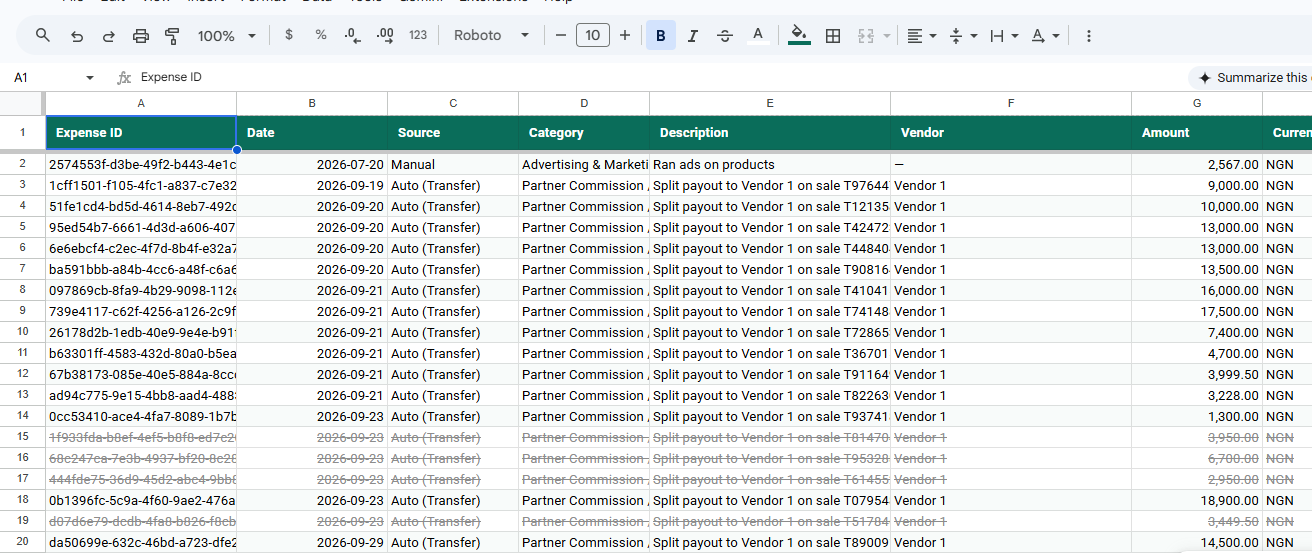
To solve cross-gateway fragmentation, you must establish a unified data schema before the transaction data ever touches your accounting software or Google Sheets. Every incoming transaction—regardless of whether it originated on Paystack, Flutterwave, or Monnify—must be translated into a standardized format containing identical parameters:
- Transaction Timestamp: Exact date and time of purchase.
- Unique Reference: The gateway's unique transaction ID for tracking and idempotency.
- Customer Identifier: Email address or phone number for customer mapping.
- Gross Amount: The total amount paid by the customer.
- Gateway Fee: The exact platform deduction (e.g., 1.5% + stamp duties).
- Net Settlement: The true amount clearing into your business account.
- Gateway Source: A clear tag identifying which provider processed the payment.
By enforcing this uniform schema, your ledger stops being a messy collage of mismatched CSV files and becomes a structured, queryable database.
3. Automating the Reconciliation Loop
Standardizing data manually is unsustainable. A robust financial architecture automates the reconciliation loop in real-time:
- Webhook Ingestion: When a payment clears on any connected gateway, the provider's server sends a real-time event payload to your automation router.
- Normalization Engine: The router instantly maps the incoming payload fields into your standardized schema, converting disparate formats into a clean, unified row.
- Ledger Appending: The normalized row is appended to your master accounting sheet or pushed directly into your ERP (like QuickBooks or Xero) within seconds.
Unify All Your Payment Gateways in 2 Minutes
Stop wasting days trying to reconcile mismatched CSV exports from Paystack, Flutterwave, and Monnify. KoboSync connects all your payment providers into a single, automated ledger[cite: 1]. The moment a transaction drops on any gateway, KoboSync normalizes the data, calculates your fees, and updates your master tracking sheet in under 3 seconds.
Final Thoughts: Clarity Is Power
A unified ledger gives financial controllers and founders absolute clarity over cash flow. When your multi-gateway data is harmonized automatically, month-end stress disappears, audits become frictionless, and your financial reports reflect the true, unvarnished health of your business.